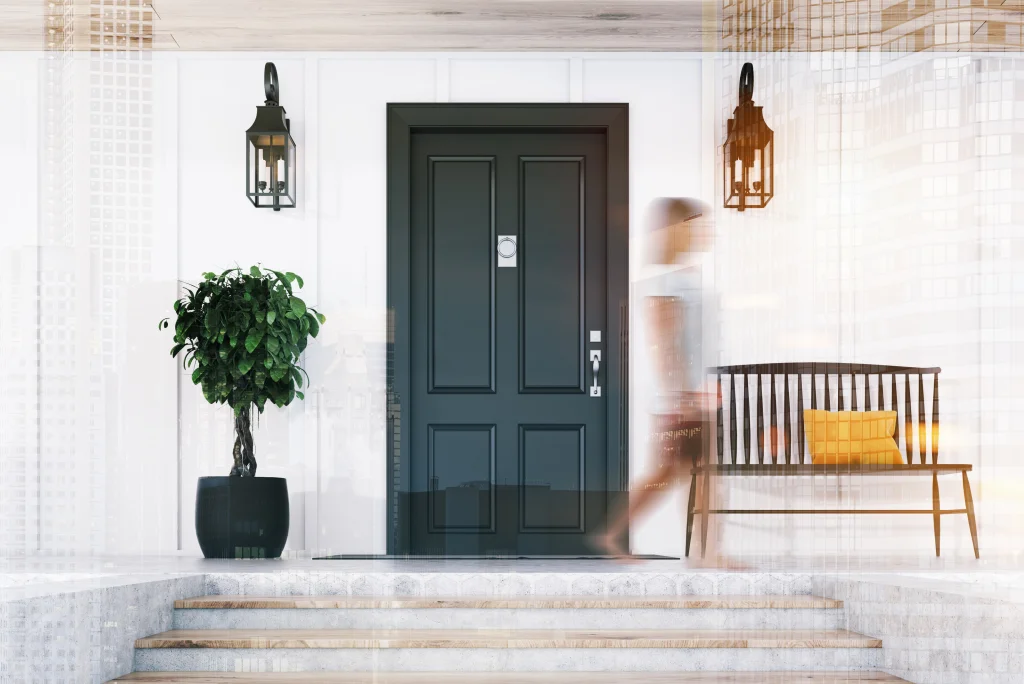
Find the Right Entry Door to Suit Your Budget and Style
Keep Your Home Safe and Beautiful with Front Doors That Offer Superior Security and Design
Brands of Entry and Front Doors

Frequent Questions Answered
Are fiberglass entry doors better than wood doors in terms of durability?
Can I install an entry door myself, or should I hire a professional?
How can I choose an entry door that complements my home's style?
Do entry doors come with energy-efficient features?
Not sure how to choose windows or doors?
Request a free consultation with a WarmDreams specialist.
Our services include:
 In-Home Consultation: Tailored advice at your convenience.
- Walk-Around Inspection: Thorough assessment by certified pros.
- Customer Care: Ongoing support, with 5-star Angi reviews to prove it. Contact us today for a no-obligation call-back and start transforming your home.
Entry & Front Door Replacement in Chicago
How Much a New Entry Door Costs in Chicagoland
A new front door doesn't just change how your entryway looks. It's often the first thing a Chicago winter tests every year, and the first thing a burglar tests every night.
In Chicagoland, a standard entry door replacement typically runs $1,200 to $4,500 fully installed. Scale up to solid wood, wrought iron, or a setup with sidelights and a transom window, and the total can climb past $5,000 to $10,000 or more.
Pricing by Material
Steel delivers the strongest security-per-dollar on this list. The catch is thermal performance: a basic builder-grade steel door without a proper thermal break will frost on the inside face during a hard January cold snap. A heavy-gauge, pre-hung unit built with a thermal break avoids that problem. Steel gauge is worth asking about directly when comparing quotes — a heavier-gauge slab resists denting and forced entry better than a lighter one, and "steel" alone doesn't tell you which you're getting.
Fiberglass is the material most contractors point Chicago homeowners toward, and for a specific reason. It reproduces the look of real wood grain, in oak, cherry, mahogany, or fir finishes, without the two failures wood is prone to here: it won't swell in July's humidity, and it won't crack when temperatures drop below zero in January.
Wood still wins on pure curb appeal, and in neighborhoods like Oak Park or Chicago's classic bungalow districts, historic preservation guidelines sometimes require it outright. The trade-off is upkeep. Wood needs periodic staining or painting to hold up against wind and moisture, an ongoing cost steel and fiberglass don't carry.
What Adds to the Bottom Line
- Sidelights and transoms: $1,600 – $4,600. Glass panels flanking the door or a window above it bring in natural light, but they require reworking the structural framing around the opening.
- Full-frame replacement: $500 – $1,000. If the existing jamb has rotted or warped, swapping just the door slab isn't an option. The contractor removes the old frame entirely and installs a new pre-hung system.
- Old door disposal: $40 – $200. Most contractors fold haul-away into the base quote, but it's worth confirming before the work starts.
Signs It's Time to Replace Your Door
A handful of situations tend to push homeowners from "maybe someday" to "let's schedule it":
- You're not the original owner. Old hardware, and an unknown number of spare keys somewhere out there, is a real security gap.
- The door is over 20 years old. That's the general service life for most entry doors. It won't collapse on its 20th birthday, but performance — sealing, insulation, smooth operation — starts to fall off well before then.
- You're mid-renovation. A new front door should match the home's updated interior and exterior.
- It's warped or sagging. Deformation over time makes the door harder to open, close, and lock properly.
- You want something that stands out. Some homeowners simply want a door that acts as the home's focal point.
ProVia Doors: What WarmDreams Installs
WarmDreams works directly with ProVia. ProVia restructured its entry-door lineup at the start of 2026, and the active series now are:
- Signet — fiberglass, the long-running flagship with the deepest woodgrain finishes and the widest design range;
- Ascent — fiberglass, ProVia's newest line, introduced in January 2026 and positioned between Legacy and Signet in price and features;
- Legacy — steel, built for security and value without the fiberglass price tag;
Ascent was designed specifically to replace the older Heritage line, consolidating ProVia's mid-tier fiberglass options into a single, more consistently manufactured product. If you've researched ProVia doors elsewhere and seen the Embarq or Heritage names, those haven't disappeared from the market so much as they've been folded into the current lineup — a WarmDreams consultant can walk through how a configuration you saw under an older name maps to Signet, Ascent, or Legacy today.
What to Look for in a Door — and a Contractor
A door is only as good as what's underneath it. Four things matter more than the finish coat:
- Material integrity. Whatever you choose, it needs to be durable and genuinely waterproof, not just water-resistant on the spec sheet.
- Fit with the home. The door should read as part of the house's architecture, not a mismatched add-on.
- Smooth operation. No squeak, no rattle, no resistance when opening or closing.
- Low maintenance after install. You shouldn't be troubleshooting your own front door six months in.
Installation quality decides whether a premium door performs like one. Even a high-end fiberglass unit will draft and underperform if the installer sets it out of level or skips proper spray foam and weatherproofing tape around the frame. Coverage on a new door runs two layers deep: ProVia backs its entry doors with a lifetime limited transferable warranty covering the door slab against warping, cracking, or delaminating, plus lifetime coverage on the insulated glass, and WarmDreams backs the installation itself with its own limited lifetime warranty.
Custom-order lead times. ProVia builds every door to order at its Ohio plant rather than pulling from stock, so factor a multi-week lead time between placing an order and installation day — worth knowing if you're timing a project around a move-in date or a season change.
Two layers of warranty coverage. The manufacturer's warranty and the installer's warranty aren't the same thing. ProVia's coverage follows the door itself; WarmDreams' limited lifetime warranty covers the installation. Ask any contractor how the two stack, since a well-built door poorly installed voids neither warranty but still fails in practice.
Steel gauge as a spec, not a marketing word. "Steel door" describes a category, not a single product. Gauge, thickness of the metal, is what actually determines how well a steel door resists denting and forced entry, and it's a fair question to ask on any quote that doesn't already state it.